
August 24, 2026
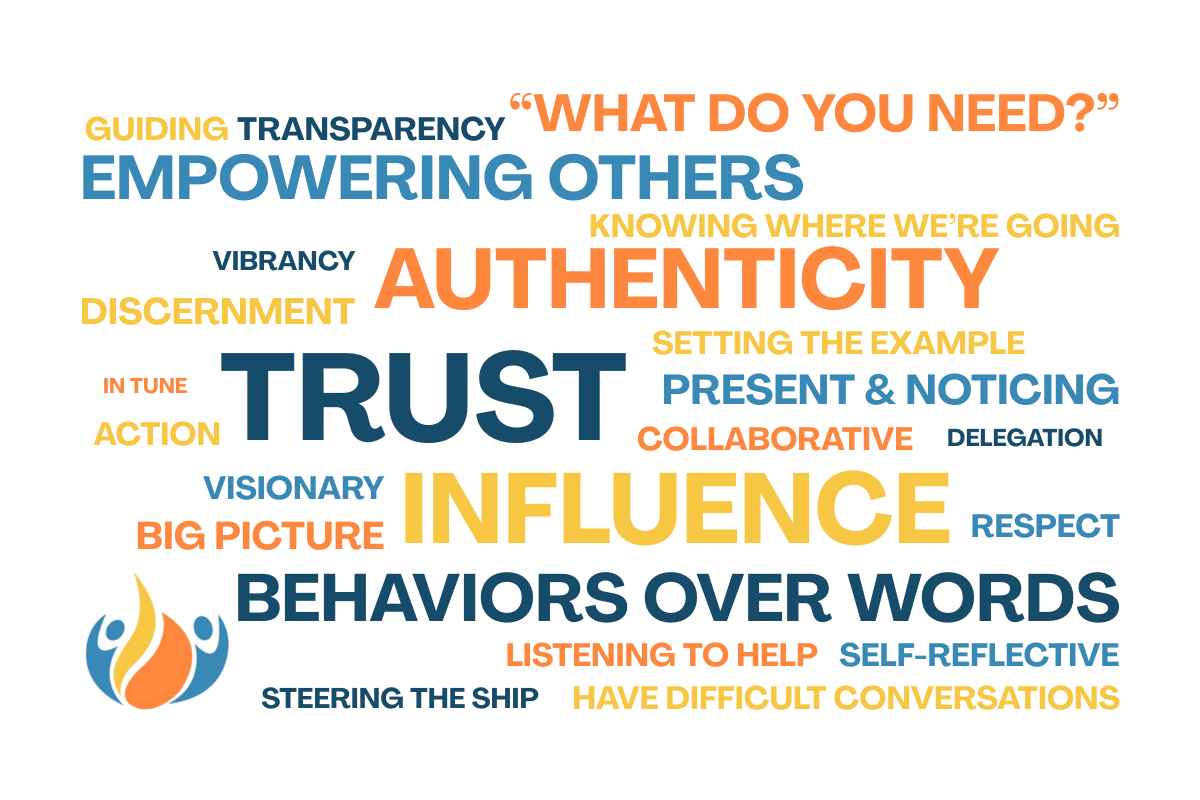
At a recent roundtable discussion focused on leadership, participants described leadership in a variety of ways, shown below:
Some of these are innate characteristics, some are rooted in relational attunement with self and others, and nearly all of them are learnable skills.
Leaders, by definition, are action-oriented and exert influence. In addition, relational leaders are deeply influenced by their relationships with others.
Leadership happens in the space between people—not to people. The quality of connections between people becomes the relational foundation for organizational effectiveness, adaptation, innovation, and overall success. In relational leadership, power does not reside in a single individual; instead, it is shared and distributed through context and dynamic human connection.
These two-way connections are built on trust, mutual influence, and a shared commitment to growth. Above all, relational leaders value growth over control. And that feels different!
Self-Awareness and Genuine Dialogue
Relational leaders are self-aware. They understand where they come from, how their identities have shaped them, and maintain deep familiarity with their own emotional landscape. They understand how they relate to themselves and to those around them. They have actively explored their biases and are not afraid to be challenged.
For relational leaders, clear communication relies upon open dialogue, active listening, and genuine curiosity. Hard conversations are not avoided. Instead, they are approached as opportunities to deepen understanding and work toward collaborative solutions. Relational team members greatly benefit from slowing down to test assumptions—whether about a project, a task, or a person—allowing them to move forward with greater clarity.
Relational leaders are not afraid to be wrong, to say, “I don’t know,” or to admit mistakes. Indeed, vulnerability can build immense respect among coworkers, even if taking such a risk feels scary. Leaders like this are often described as “real,” “grounded,” or “speaking truth” (trustworthy).
Redefining Vulnerability and Psychological Safety
Vulnerability is being redefined in modern leadership, moving from a perceived weakness to a profound strength.
Dr. Brené Brown, in her research, defines vulnerability as the utmost courage: the ability to show up and be seen without controlling outcomes, needing to be right, or hiding behind armor.
"Vulnerability is the glue that holds relationships together. It’s the bridge to connection." — Brené Brown
When leaders and team members let go of the need to have all the answers or appear invulnerable, they create psychological safety. Though a separate concept, this practice, too, opens up the space between people for genuine dialogue, trust, and innovation to take root.
Psychological safety develops when there is freedom for interpersonal risk-taking. In other words, colleagues don’t worry about being humiliated or punished for making mistakes, offering a differing opinion, or sharing constructive feedback—provided it is done thoughtfully and kindly.
"In business, taking risks is necessary for innovation and growth. Psychological safety allows people to take those risks without fear of negative consequences to their self-image, status, or career." — Dr. Amy C. Edmondson
Feedback, Intent, and Impact
Feedback is an essential part of relational leadership. Both affirming and constructive data drive growth. Though much fear and misconception surround feedback, it becomes incredibly valuable when viewed simply as data to be considered and further tested through inquiry.
Effective feedback also involves knowing and naming feelings. Relational leaders stay in touch with their emotions, utilizing them as a rich source of information about team climate and culture. They are not afraid to name these feelings in important conversations.
When we see the space between us filled with curiosity, feelings, feedback, and supportive gestures, it is no longer empty; it becomes rich with meaning and insight. Using descriptive language to label this space and inquiry to harvest another’s perspective on it leads to new depths of understanding. When that space becomes challenging, exploration is even more vital to clear away assumptions and misperceptions so team members can know each other more fully.
Furthermore, relational leaders understand the crucial difference between intention and impact. They may have the best of intentions, but if their actions hurt or offend another person, they take responsibility to make it right. Good intentions do not erase negative impact. However, naming intentions, especially in advance of tough conversations, can help reduce defensiveness and foster openness. Naming intentions also helps a relational leader become known, articulate their values, and demonstrate them in real time.
The Art of Repair
Conversations don’t always go as planned. Having the willingness, knowledge, and competence to repair damaged connections is a vital relational leadership skill.
Many people lack role models for healthy repair. Relational leaders take the time to recognize when repair is needed, respond intentionally to the individual and the situation, and work patiently to rebuild the relationship.
It is rarely quick or easy. Yet, the relational leader asks themselves: “Is this connection worth taking the time to repair?”
They may even ask the other person that exact question as a starting point. And when necessary, relational leaders possess the resilience to withstand a “no,” even when it is painful. A "no" doesn’t necessarily mark the end of a relationship. It simply establishes a new boundary to work within moving forward.
Repair doesn’t mean that two people end up seeing the same way. Instead, through dialogue they can see their differences more clearly, understand them more fully, and deepen into the ‘why’ for each. Ideally, they can then hold differences with care and respect. Indeed, it is a leadership skill to be able to hold differences and stay in connection.
Join the Journey
These and other core components of relational leadership will be featured in my upcoming 8-week virtual cohort: Exploring the Space Between: Relational Leadership at Work and in Life.
Ready to transform how you lead and connect? Register Here to reserve your spot. You are worth it!



.svg)
.svg)