August 17, 2026
.png)
The evening after my friend’s memorial, Paula blew up at me. Granted, the day was filled with lots of feelings and some pressure to honor our friend in meaningful ways. For me, this seemed to come out of nowhere.
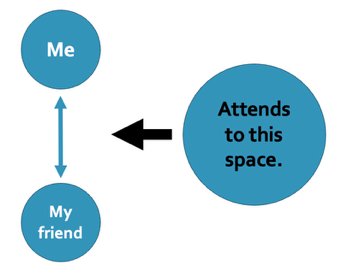
She lives in in a different state and we make it a habit to see each other annually and talk occasionally. I took for granted the space between us and the connection we had based on my own perception and worldview. To me, the connection felt solid and warm, with just a little distance and mutual supportiveness.
However, her space between was filled with very different things than mine—things like resentment, anger, discomfort, and depletion. Things had been building up that I didn’t know. She hadn’t told me. And I didn’t inquire.
We will revisit this scenario and a work scenario shortly.
In any relationship, there is a space between. It is mysterious, filled with emotions, assumptions, dreams, and mental models—all based in cultural, social, psychological, and familial norms. Often unexplored and sometimes taken for granted, it is a rich source of information.
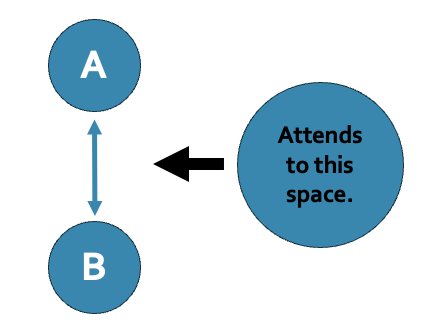
Relational leadership focuses on that space in between two people as a place to be explored. Leadership resides right there in the space between when you take relational actions to make the unknown more known and bring language and your reality to this space.
What is "The Space Between"?
To start exploring the space between, we can look at it literally—like the physical space between me and you, or me and a tree, or me and that fast-approaching car.
We can also look at it metaphorically:
In some spiritual traditions, this space is believed to be where God lives. It has been named as the sacred moment between the in-breath and the out-breath, or the gap between a living person and a loved one who has passed away. We find this powerful metaphor across literature, philosophy, psychology, and art throughout time.
The space between can be the gap in what an artist creates and what is perceived. The mystery of meaning and feeling created by art. What was her intention? What is my experience?
"The space between the words is where the meaning lies.” — Virginia Woolf
"True art is not in the rendering of the object itself, but in the space between the object and the viewer's eye." — Unknown
Living in Liminal Space
Liminal space exists between transitional states, between what has been let go and what has not yet begun, or between you and the life you are creating.
We are all living in liminal space, always. However, it is those big moments of transition that remind us of this reality, much like an empty gas station represents the potentiality of a journey.
"It is not the transition that comes to mind when we look back at our lives, but the liminal state—the time between what was and what will be. That is where we are truly made." — William Bridges, Transitions: Making Sense of Life's Changes
Relational Leadership and Connection
What I want to explore more, as a foundation of relational leadership, is the space between people: me and another.
Martin Buber named it “I and Thou” to underscore the sacredness of that space, moving beyond the transactional to the connective. In that distance or gap, we cannot really know another’s experience—what they are thinking, feeling, or perceiving—without explicit inquiry and exploration. This kind of inquiry goes beyond mere information to engage our humanity.
“Communication is merely an exchange of information, but connection is an exchange of our humanity.” — Sean Stephenson
A broken bridge is a common metaphor for the misunderstandings and miscommunications between two people. In our culture, we are simply not trained to pay attention to the space in between or given the language to name what is there. Yet these spaces are embedded with richness, questions, unspoken assumptions, and energy, even when they seem empty.
"Connection is the energy that exists between people when they feel seen, heard, and valued; when they can give and receive without judgment; and when they derive sustenance and strength from the relationship." — Brené Brown
What Does This Have to Do with Leadership?
Before we can explore relational leadership, we must define what leadership is not:
A leader is a person who chooses to act, to harness their will, to influence. Ideally this happens in collaboration, while listening for collective intelligence, creating psychological safety and inclusion, and being willing to take risks and be vulnerable.
A relational leader does this in service of the relationship (whether with a partner, neighbor, or teammate) and in service of the whole (whether a work team, family, sports group, or community).
We are all leaders, and we can choose to enact our leadership relationally. We are also followers, and sometimes simply members. It is especially important to think about influence in significant relationships—with the people you influence, and the people who influence you.
A Personal Example: Navigating the Space Between
Getting back to the example with my friend, after the blow up, she went to her room for the night. She made an important decision to take some space away. Then my relational leadership choice became whether to repair. My answer was yes. We had a conversation the next morning. I listened and apologized for hurting her. Yet, I wanted more of a two-way dialog. To me it felt like a band-aid, not fully mutual. I'm not sure how it felt to her.
My next leadership choice is whether to take that repair further. I haven’t decided yet if it is worth it—are we worth it?
In another work scenario, I got feedback about my body language, specifically my tendency to smile and even laugh at challenging moments with clients. My boss was curious whether I was uncomfortable and this was an unconscious habit or whether I was trying to help others feel comfortable. I have to say that this conversation was uncomfortable! However, he brought the subject up with data (my observed behavior pattern) and curiosity about around his assumptions. He gave me examples and then time to check in with myself. Given the examples, I discovered that both assumptions were true at different moments. We took the time to have an important developmental conversation which helped me hold steady during challenging moments.
Choosing to Enact Relational Leadership
To explore the space between, we need to take space and make space—both inner and outer. Inner space is expanding the moment between how we are stimulated and how we respond. Outer space is taking a break, when necessary, and coming back to process and repair.
If the relationship is worth it, each person must realize they have a choice. We can choose how to respond, remain curious, and listen without defense. It takes time, but for significant relationships, it is worth the investment.
"Between stimulus and response there is a space. In that space is our power to choose our response. In our response lies our growth and our freedom.” — Viktor Frankl
The Benefits of Doing the Work
I continue to work on creating more space within myself to enact relational leadership, and I encourage you to try it, too.
Join Me on the Journey
Exploring the Space Between: Relational Leadership at Work and in Life
8-Week Interactive Online Journey | Oct 1 – Nov 19, 2026 | 8:30a – 10:30a CT
Together, we will learn practical skills to see and language "the space between." You will learn how to approach significant people in your workplace and personal life to check assumptions, clear miscommunications, and build deeper connections. Specific outcomes include:
See you in October!



.svg)
.svg)